Monday, May 08, 2006

au revoir

After last week's local elections, there have been some ministerial reshufflings.

David Miliband, the now ex-minister for local government, has moved on to Defra and his blog has, too - it should now be at:

http://www.davidmiliband.defra.gov.uk

I hope the new minister, Ruth Kelly, picks up blogging on local government and community issues where Mr Miliband left off on the DETR, DTLR, ODPM DCLG site.

Back to main page

Thursday, May 04, 2006

productive partnerships - is it something in the water?

Topics: partnership development, rural, children and young people, skills and capacity

Yesterday I was in the spa town of Buxton - the sun was shining, the flowers blooming, the Peak District lambs were gambolling. However, I was in a windowless auditorium.

But it was worth it. I spent the afternoon at a learning event for the Peak DistrictPerformance Improvement Partnership (PIP).

PIP activites are centred around a programme of projects that received funding through the ODPM's Capacity Building Fund. Unusually, the Peak District National Park Authority, rather than a council, is the coordinating agency - other partners were Derbyshire County Council, Derbyshire Dales District Council, High Peak Borough Council, Staffordshire Moorlands DC and the Lake District NPA.

As partners, they used the CBF to develop approaches to building leadership and management skills and organisational learning and capacity. Their approach seemed to be focused on learning by doing - though they have supported this learning with training and formal and informal networking.

Some of their projects would be of particular interest to rural authorities, others - some of which focused on improving community engagement would be of interest to any public sector bodies. Especially interesting was some of their work engaging young people through youth forums and in schools. In response to the usual youthful cry of "there's nothing to do", young people in the area are setting up a website, with reviews of activities and a 'what's on' feature that will be available this summer. (I, too, was a teenager in a rural area. There is little to do, but you can make your own fun.)
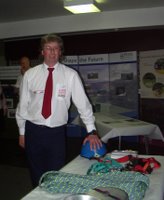
There was also an interesting project which introduced looked after children to the park, countryside skills and rock climbing. Pictured Park Ranger Andy McGraw explains how the programme worked at yesterday's learning event.

Jim Dixon, the Chief Executive of Peak District NPA described some of the benefits as:


  • share learning
  • outcome based partnership
  • maximising effectiveness of democracy
  • the chance to innovate
  • developing a learning approach
  • and building the trust and confidence among partnes that they can 'deliver together' through future challenges.

Over the next few months, Programme Manager Nic Hutchins will be drawing out some of the broader lessons from their work and we hope to share that here and elsewhere. In the meantime, she contributed to the online conference on partnership governance and performance last Autumn and the conference report is on IDeA Knowledge. There is a also a publication about partnership working in the region Derbyshire: An Excellent model of partnership working - A case study (link to a pdf) on the Local Government East Midlands website.

By the way, there are PM case studies on both Derbyshire County Council and Derbyshire Dales DC as part of the Performance Management, Measurement and Information project.

Back to main page

quick hit - PFI report from HM Treasury

Topics: reports, PFI, procurement, private sector

The Treasury has published a document on private finance initiatives called PFI: Strengthening long-term partnerships (link to a pdf file). It sets out government's ongoing committment to PFIs and includes a chapter on improving operational performance and flexibility in private finance initiatives.

Back to main page

Wednesday, May 03, 2006

New on Knowledge

Topics: health, case studies, partnerships

What's new on IDeA Knowledge?

A year of healthy living - features case studies month by month focusing on healthier communities:

Inspired by the four Beacon Councils for healthy communities, the calendar also includes bright ideas gathered by the Centre for Public Scrutiny and drawn from initiatives such as Shared Priorities and Communities for Health. It shows how small changes enacted across a wide range of public services can make a big difference in health outcomes.

May's healthy living stories include several partnership successes:

Brighton and Hove's Active for Life programme:
With the clear aim of getting more people, more active, more often, Brighton and Hove City Council and Brighton and Hove City Teaching Primary Care Trust came together to create ‘Active For Life’.

Bootle L2Ozone case study (PDF, 5 pages, 43KB) (PDF, 5 pages, 116KB) The Bootle L2Ozone, a virtual health and wellbeing ‘zone’, brings together a group of voluntary, health, community and statutory service providers in Bootle. It has revolutionised the way people receive and engage in health and community services bringing together a range of services and providing the right community marketing.


Back to main page

Tuesday, May 02, 2006

Holding each other to account

Topics: accountability, performance

I mentioned the other day that I was at an event. One of the interesting things I picked up was the idea of Kipling's friends. What are Kipling's friends? Well, they're not the juicy sultanas that make his cakes so exceedingly good. It's a line from one Rudyard Kipling's poems:

"I keep six honest serving men: They taught me all I knew: Their names are
What and Why and When and How and Where and Who”

Pete Franklin from Bristol City Council, uses Kipling's friends to help scrutiny councillors structure their questions about performance. It's simply a prompt, but a useful one - especially for new councillors in strengthening accountability within the council.

I shared this in the PMMI discussion forum and got some useful tips, here's what I came up with:

Why is performance below target?
-Are you sure?
-Is there any other reason?
Is this indicator an appropriate measure of performance?
-What else should we know?
What are the implications of not meeting this target?
-Will this affect our corporate priorities.
-Will it affect our partners?
-Is there an impact on other targets?
-Is there an impact on equalities, sustainability or efficiency?
What performance do you predict for the next month/quarter?
-How good was your forecast last time?
-Have you identified all the risks to achievement?
How will performance be improved?
-Will that fix it?
-When will it be achieved?
Who is responsible for improving performance?
-Can other services or teams contribute to improvement?
What happens if performance doesn't improve?
-Will additional funding/ resources be needed? Can you move them from elsewhere?
-How will underperformance be addressed?
What decision do you need us to take?
-What do we need to know to make a decision?
-What are the risks in the assumptions we might make?

But it got me to thinking about whether there are any similar tools for supporting accountability within partnerships and between partners. Questioning styles in partnerships will no doubt be different. Has anyone come up with something that's helpful?


Back to main page